
Are payment gateway charges reducing your online store's profit?
If you sell products through Shopify, WooCommerce, Instagram, or WhatsApp, payment fees are an important business expense.
Some payment providers charge a percentage of every successful sale. This means your payment costs increase as your sales grow.
But what if you want to accept online payments without paying a percentage commission on every sale?
For businesses that mainly receive local bank transfers, a fixed-price payment verification service may be a better option.
In this guide, we explain what 0% transaction fees mean, how different payment methods work, and how DPay helps Pakistani businesses reduce percentage-based payment charges.
What Does a 0% Transaction Fee Mean?
A 0% transaction fee means a payment service does not deduct a percentage of each sale.
For example, imagine your store receives a payment of Rs 10,000.
If a payment provider charges 2%, you pay Rs 200 in transaction fees.
If a service charges 0% commission, it does not deduct that percentage.
However, 0% commission does not always mean the service is completely free.
Some providers may charge:
- Monthly or fixed-period subscription fees.
- One-time setup charges.
- Fees for additional services.
- Charges when usage limits are exceeded.
Your bank or wallet may also apply its own transfer fees.
Always check the complete pricing before selecting a payment service.
How Much Do Payment Gateway Fees Cost?
Let's understand this with a simple example.
Imagine your online business receives:
- 100 orders per month.
- Average order value of Rs 5,000.
- Total monthly sales of Rs 500,000.
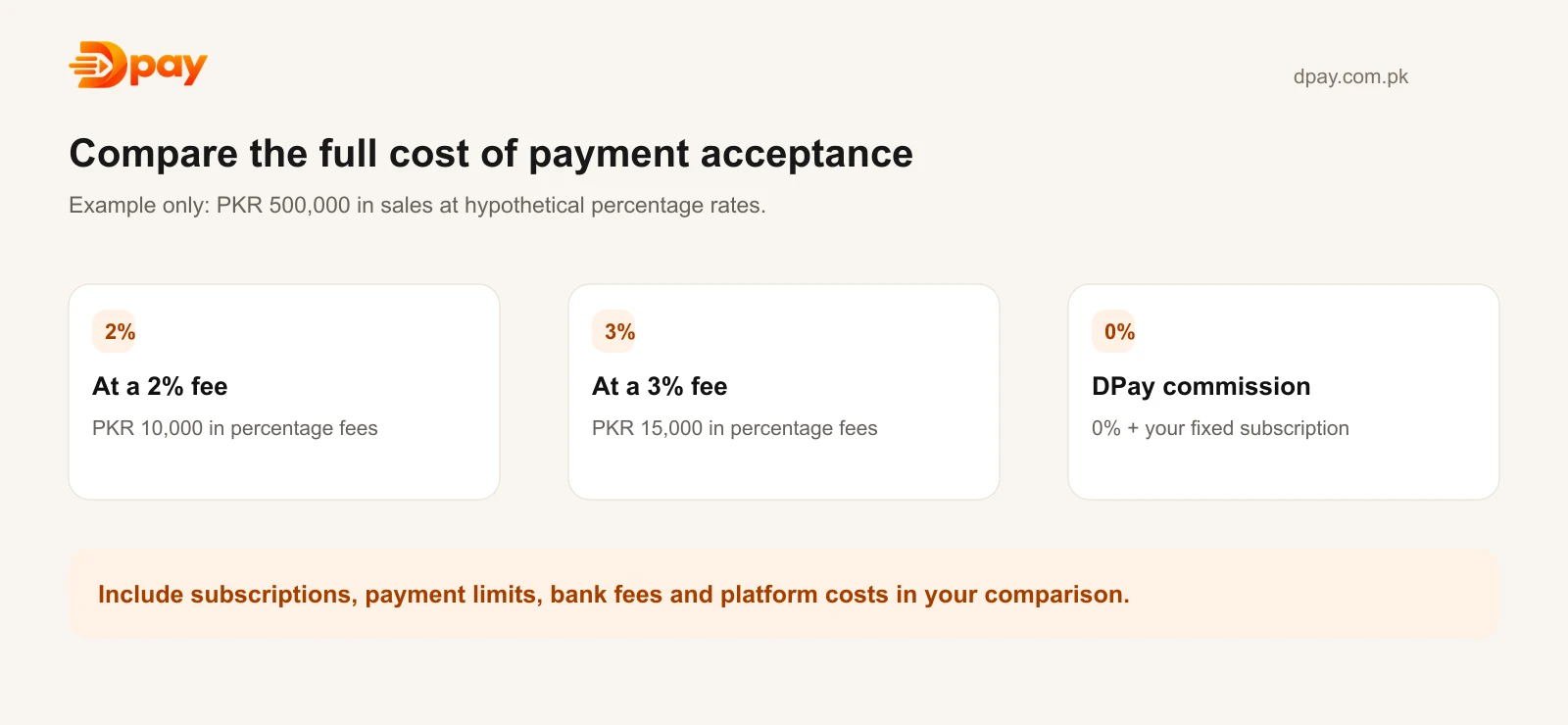
Here is how hypothetical percentage-based fees affect your revenue.
| Monthly Sales | 2% Fee | 3% Fee |
|---|---|---|
| Rs 100,000 | Rs 2,000 | Rs 3,000 |
| Rs 250,000 | Rs 5,000 | Rs 7,500 |
| Rs 500,000 | Rs 10,000 | Rs 15,000 |
| Rs 1,000,000 | Rs 20,000 | Rs 30,000 |
These are illustrative calculations, not the prices of any specific payment provider.
As sales increase, percentage-based charges also increase.
This is why many Pakistani online sellers look for payment options with no percentage commission.
Can You Accept Payments Without Percentage-Based Commission in Pakistan?
Yes. Several payment methods may allow businesses to avoid percentage-based gateway fees.
The right choice depends on your customers, your website, and whether you need automatic payment confirmation.
Option 1: Manual Bank Transfers
One of the simplest solutions is to accept payments directly into your bank account.
Your customer:
- Places an order on your website.
- Receives your bank account details.
- Transfers the payment.
- Shares a payment reference if needed.
- Waits for you to verify the transfer.
This method does not require a traditional payment gateway.
However, manually checking payments can become difficult when your business starts receiving many orders.
It also creates a risk of mistakes if a payment screenshot is incorrect or the money has not actually arrived. A screenshot is optional supporting information; confirm receipt in your account before fulfilling the order.
Option 2: Raast Payments
Raast is Pakistan's instant payment system, developed by the State Bank of Pakistan.
It allows participating financial institutions to support digital fund transfers.
Customers can use supported banking apps to transfer money.
Depending on the bank and merchant payment product, Raast may offer low-cost or zero-fee payment acceptance.
However, businesses should always confirm the fees and terms offered by their bank.
A basic standalone Raast transfer does not by itself update a WooCommerce or Shopify order. An integrated merchant-payment product may provide order updates. SBP’s Raast guidance describes P2P transfers; its merchant-payment rules address P2M acceptance and merchant fees.
Option 3: DPay — Automatic Bank Transfer Verification
DPay is a Pakistan-focused payment verification platform.
It helps businesses accept direct bank transfers and automatically confirm supported payments.
Unlike traditional percentage-based card payment gateways, DPay uses a subscription-based pricing model.
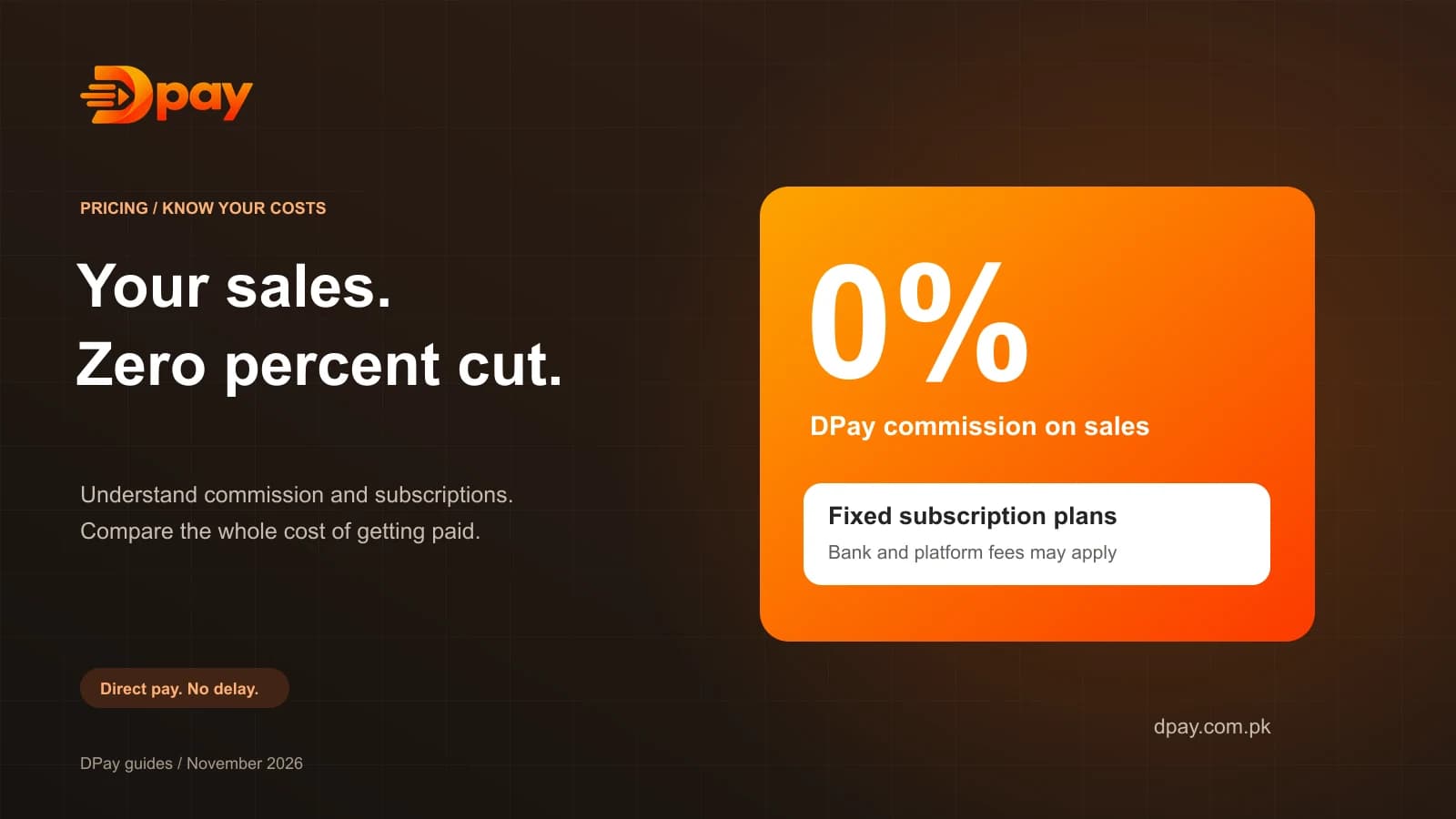
DPay advertises 0% commission on sales.
This means DPay does not deduct a percentage from every verified sale.
Instead, merchants subscribe to a plan based on their business requirements.
DPay can be used with:
- WordPress and WooCommerce.
- Shopify.
- Custom websites through API integration.
- Payment links and invoices.
- Supported local bank and wallet transfers.
You can explore the service at DPay.com.pk.
How Does DPay Work?
DPay provides an automatic payment verification system for Pakistani businesses.
Here is how the process works.
Step 1: Customer Places an Order
A customer visits your Shopify or WooCommerce website.
They select a supported bank-transfer payment option.
Step 2: Customer Transfers Money
The customer receives the payment amount and merchant account details.
They can use a compatible banking or wallet app, such as Easypaisa, JazzCash, or another supported service, to send money.
Step 3: DPay Checks the Payment
DPay verifies that the transfer reached the merchant’s supported receiving account.
When the transfer is successfully verified, DPay records the payment.
Step 4: Website Order Is Updated
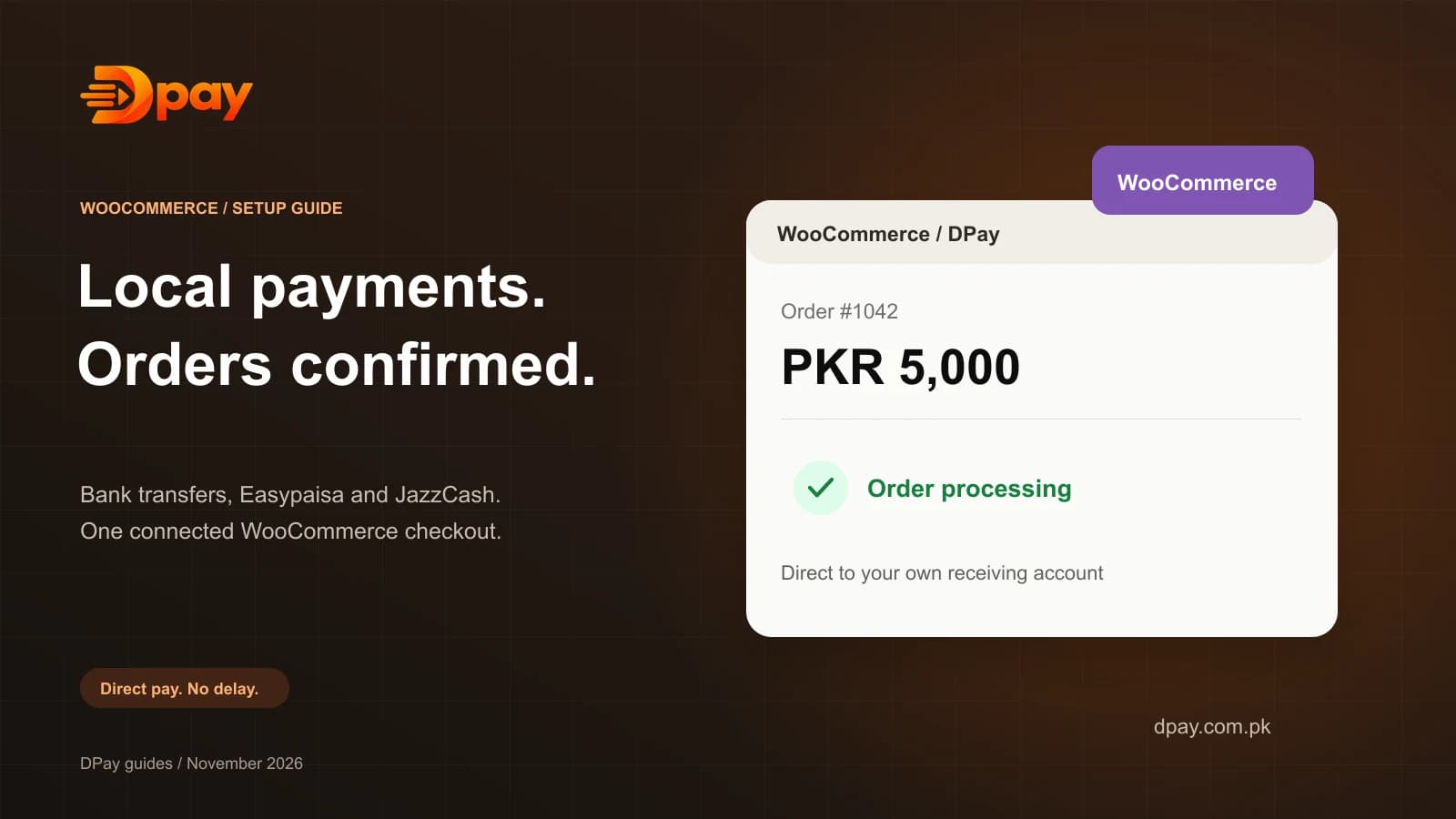
When the integration is configured correctly, DPay can automatically update the payment status of the relevant WooCommerce or Shopify order.
The merchant does not need to manually approve a screenshot for every successfully verified payment.
If a payment cannot be matched safely, it may require manual review.
Where the Money Goes
The customer's payment goes into the merchant's supported receiving account.
DPay does not hold or settle the customer's funds.
This makes DPay different from payment processors that receive customer funds and settle them to merchants later.
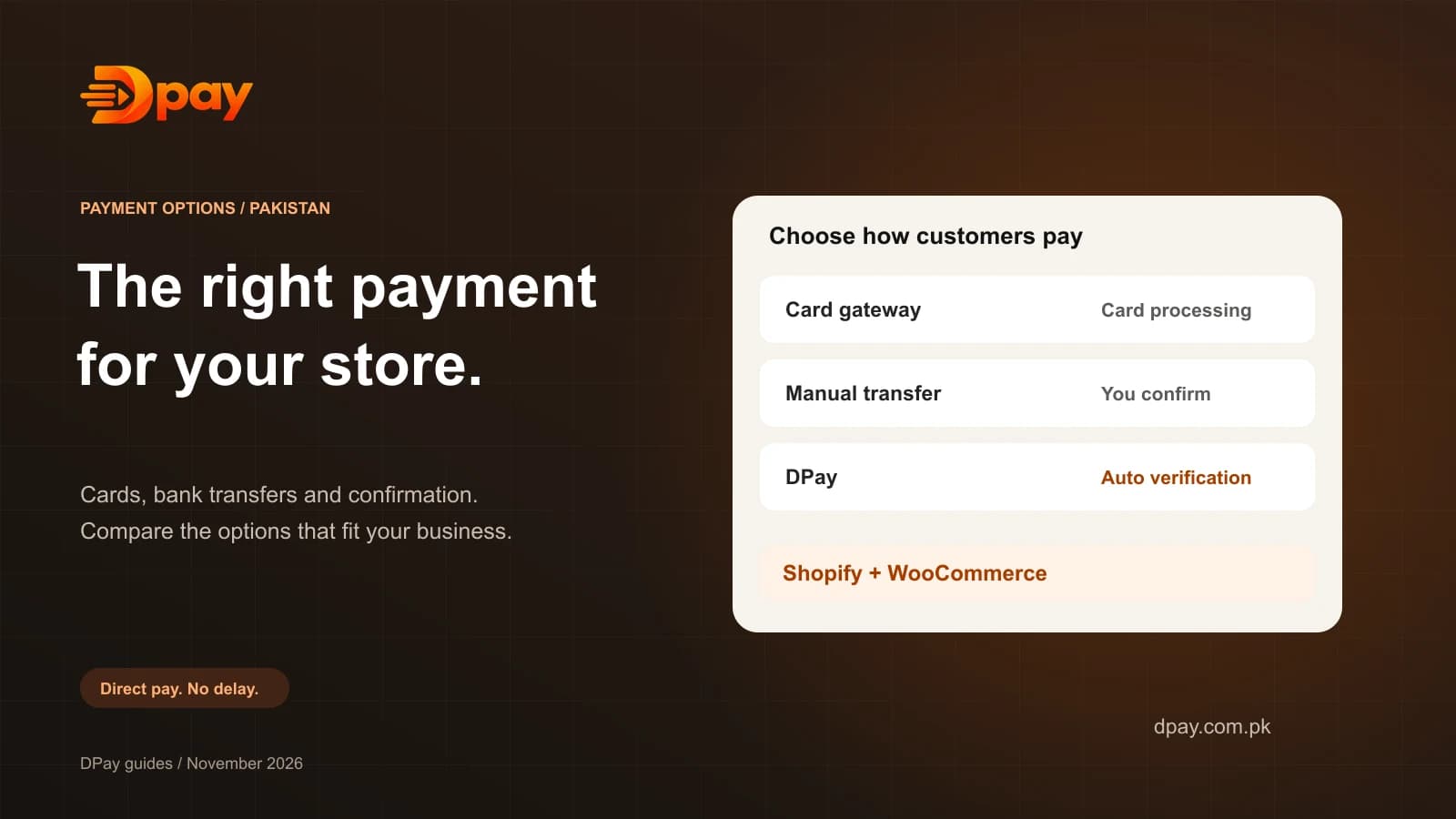
DPay vs Traditional Payment Gateways in Pakistan
The following comparison explains how the two payment models differ.
| Feature | Traditional Payment Gateway | DPay |
|---|---|---|
| Percentage-based fees | Often charged | 0% DPay commission |
| Pricing model | Frequently transaction-based | Subscription-based |
| Debit/credit cards | Often supported | Not supported |
| Bank transfers | Depends on provider | Core payment method |
| Automatic verification | Usually available | Available for supported transfers |
| WooCommerce integration | Provider-dependent | Available |
| Shopify integration | Provider-dependent | Available |
| Holds customer funds | Depends on provider | No |
DPay is not a replacement for every type of payment gateway.
Businesses that need debit or credit card processing may still need a traditional payment processor.
However, stores that mainly receive local bank transfers may benefit from DPay's payment verification model.
Is DPay Completely Free?
DPay offers a trial and paid subscription plans.
Its 0% commission applies to DPay's percentage-based deductions from sales. It does not mean there are no subscription costs or potential bank charges.
Compare DPay plans by:
- Number of payments allowed.
- Number of connected receiving accounts.
- Available features.
- Business usage requirements.
For the latest details, visit the official DPay pricing page. Payment allowances count created checkouts, including unpaid sessions; the monthly meter resets on the first day of the month in Pakistan time. Paid subscriptions run for 30 days. Check both your checkout count and your completed sales when comparing costs.
Why Do Shopify and WooCommerce Stores Need DPay?
When a customer pays through a manual bank-transfer method, the ecommerce platform does not normally know whether the transfer arrived.
The store owner must verify the payment.
This takes time, especially for businesses receiving many orders.
DPay helps automate payment confirmation for supported transfers.
Benefits for WooCommerce Stores
- Install the official WooCommerce integration.
- Allow customers to select a local bank-transfer payment option.
- Receive automatic confirmation of successfully verified transfers.
- Update the relevant order without manually checking screenshots.
- Avoid DPay percentage commission on sales.
Read the DPay WooCommerce integration guide.
Benefits for Shopify Stores
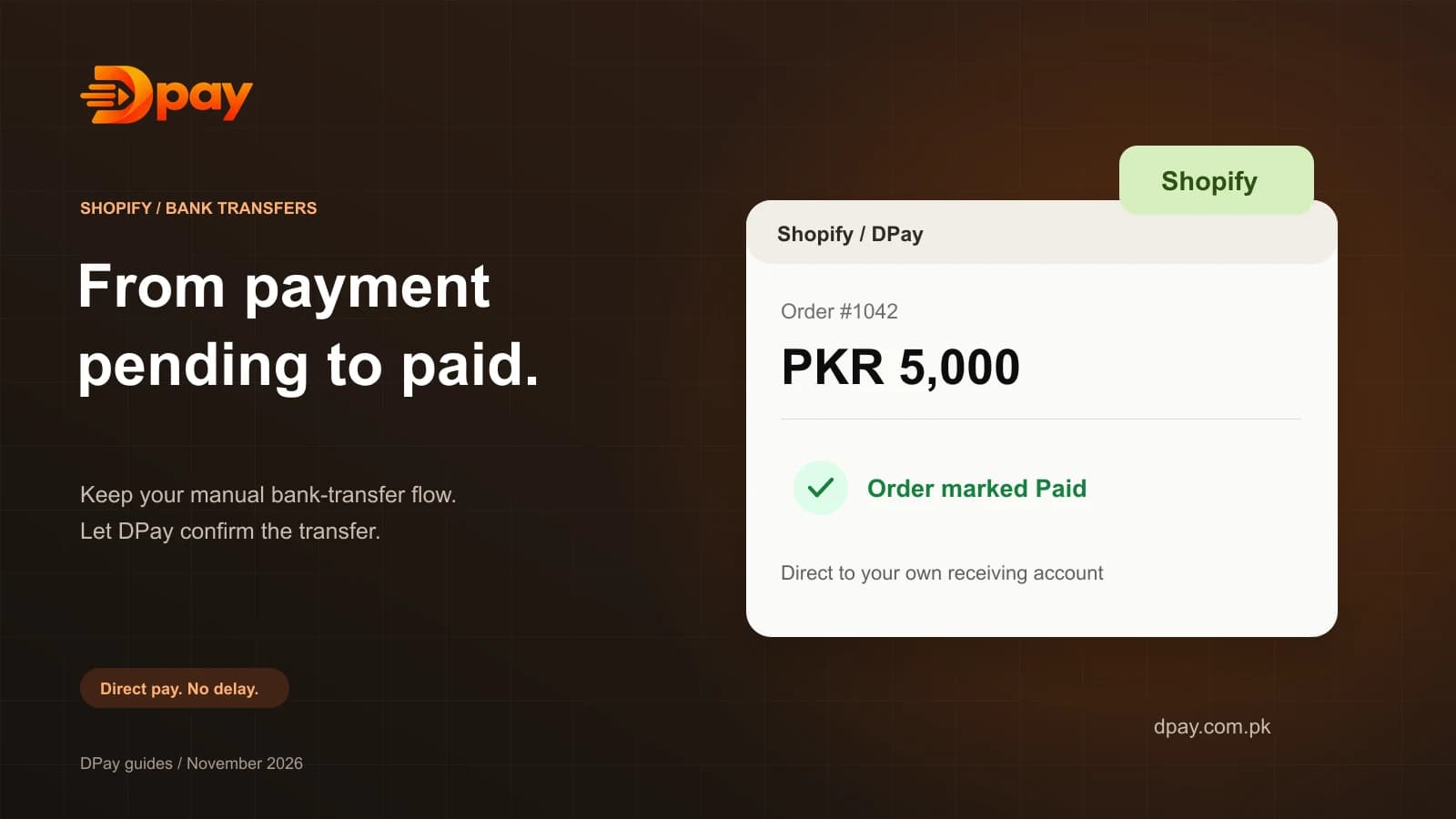
- Work with Shopify's manual bank-transfer payment system.
- Display payment instructions to customers.
- Verify supported incoming transfers.
- Automatically confirm eligible orders using the configured integration.
- Reduce manual payment checking.
Read the DPay Shopify integration guide. Shopify’s manual-payment documentation says third-party transaction fees do not apply to manual payments. Shopify subscriptions, DPay subscriptions and applicable bank charges are separate costs.
Which Businesses Can Benefit from 0% Commission Payments?
A zero-percentage-commission model may be useful for different types of businesses.
1. Ecommerce Stores
Online sellers who receive frequent local bank transfers can reduce the time spent confirming payments.
2. Instagram and WhatsApp Sellers
Social media sellers can use payment links and keep track of incoming transfers.
3. Freelancers and Agencies
Service providers can send payment requests to clients and track whether payments have been received.
4. Educational Businesses
Training institutes and course providers can use payment verification tools to track fees and registrations.
5. Growing Online Brands
Businesses with increasing order volumes can compare fixed subscription costs against the percentage-based costs of other payment solutions.
The most suitable option depends on customer payment preferences and business requirements.
Frequently Asked Questions
1. Is there a 0% transaction fee payment gateway in Pakistan?
Yes. Some payment solutions offer 0% percentage commission. DPay is one option for businesses accepting supported local bank transfers.
DPay uses subscription-based pricing, so 0% commission does not mean unlimited free use.
2. Does 0% commission mean no charges at all?
No. A 0% commission service may still charge subscription fees, setup costs, or additional service fees.
Banks and wallets may also charge their own fees.
Always review the full pricing before choosing a provider.
3. Which payment solution has no percentage deduction in Pakistan?
For supported direct bank transfers, DPay advertises 0% commission on sales.
If you only need basic payment acceptance, a manual bank-transfer method can also avoid third-party gateway commission, although payment checking remains your responsibility.
4. Can I accept Easypaisa and JazzCash without paying a percentage fee?
Customers can make supported transfers using Easypaisa, JazzCash, and compatible banking apps.
DPay can help verify these incoming transfers without deducting a percentage commission.
However, this is a bank-transfer verification solution, not a direct replacement for the official merchant APIs of those wallet providers.
5. Does DPay work with Shopify in Pakistan?
Yes. DPay offers a Shopify integration for bank-transfer payment confirmation.
It works with Shopify's manual payment flow and can automatically update eligible orders after successful verification.
6. Does DPay work with WordPress and WooCommerce?
Yes. DPay provides a WooCommerce plugin that connects your store to its payment verification service.
You can follow the official installation guide to configure the plugin and API key.
7. Can DPay automatically verify bank transfers?
Yes. DPay verifies that supported incoming transfers have reached the merchant’s receiving account.
It can then send payment updates to a connected website.
Payments that cannot be safely matched may need manual review.
8. Does DPay support debit and credit cards?
No. DPay focuses on bank-transfer verification rather than debit and credit card payment processing.
If your business needs card payments, you should consider a compatible card-processing gateway.
9. Does DPay hold customer money?
No. According to DPay's published model, payments go directly into the merchant's receiving account.
DPay provides the software used to track and verify supported transfers.
10. What is the best payment option for a small business in Pakistan?
It depends on how your customers prefer to pay.
If you receive only a few bank transfers, manual verification may be enough.
If you use WooCommerce or Shopify and regularly receive local transfers, an automatic payment verification service such as DPay may save time.
If your customers prefer cards, choose a card-processing provider that supports your business.
11. Is DPay cheaper than a traditional payment gateway?
It can be cheaper for some businesses, especially those receiving many eligible bank transfers.
However, the total cost depends on DPay's subscription price, payment volume, applicable bank fees, and the alternative provider's pricing.
Compare the full costs before deciding.
12. Can I use DPay on a custom ecommerce website?
Yes. DPay provides API integration options for developers.
Businesses can use the API to create payment requests and receive payment status updates through supported webhooks.
See the DPay developer documentation.
Final Thoughts: Choose the Right Payment Solution for Your Business
Payment charges can affect the profitability of an online business.
For merchants in Pakistan, choosing the right payment solution means looking beyond transaction fees.
You should consider payment methods, verification speed, website integration, subscription costs, and customer experience.
Traditional payment gateways can be useful for card payments.
Manual bank transfers can work for smaller businesses.
But if your store receives regular payments through local banking and wallet apps, automatic bank-transfer verification may be a practical solution.
DPay helps Pakistani businesses verify supported direct transfers, automatically update connected ecommerce orders, and avoid percentage-based DPay commission on sales.
Start Accepting Bank Transfers with DPay
Want to stop checking every payment screenshot manually?
DPay can help your business:
- Receive money directly into your supported bank or wallet account.
- Automatically verify eligible incoming bank transfers.
- Connect payment confirmation with WooCommerce or Shopify.
- Track payments using one dashboard.
- Avoid percentage-based DPay commission on sales.
Explore DPay and choose the plan that fits your business.
Disclosure: This article is published by DPay and describes its own payment verification service. Features, supported receiving accounts, and pricing are subject to the current service terms.
Sources & official guides
Reviewed 2 November 2026. Product availability, supported accounts and fees can change; check the provider’s current terms.

Published by DPay, a bank-transfer payment verification service by DOWNLABS in Lahore, Pakistan. DPay charges subscription fees with 0% commission on sales. Payments go directly into the merchant’s supported receiving account.